 Figma
Figma API
API Web to code extension
 Adobe XD
 Discord
 Twitter
 GitHub


 Blog
Blog
Google I/O 2026: AI is the interface of everything, and digital employees are coming next14 min read
Reading Time: 10 minutesGoogle I/O 2026 was not just a developer conference about AI features. It was Google saying, very clearly: AI is becoming the interface layer for almost everything, and digital employees for everyone are starting to look real.
I watched the keynote and read the big roundups from Google, The Verge, WIRED, TechCrunch, AP, TechRadar, and others. The obvious story is “more Gemini.” The more interesting story is that Google is trying to move AI from a chat window into the places where work already happens: Search, Gmail, Workspace, Android, Chrome, shopping, creative tools, and developer environments.
My read: this is the moment the AI race becomes less about who has the best model demo, and more about who owns the workflow around the model.
For designers and engineers, that matters a lot. For SMBs, it may matter even more. The next wave is not only better assistants. It is hosted agents, digital employees, that can run tasks, remember context, use tools, and operate safely enough for real business workflows.
Try Anima Playground if you want to turn an idea, Figma design, screenshot, or URL into a working, on-brand prototype you can actually inspect, iterate, publish, and hand off.
The brief: what Google actually announced at I/O 2026
The official Google framing was “the agentic Gemini era.” That phrase is marketing, but the announcements behind it are real enough to pay attention to.
Google introduced the Gemini 3.5 family, with Gemini 3.5 Flash becoming the default model in Gemini and AI Mode in Search. Google positioned it around speed, coding, agentic workflows, and richer interactive UI generation.
Google introduced Gemini Omni, a multimodal model family meant to work across text, image, audio, and video, not as separate media tricks, but as one more unified creative surface.
Google talked about an “intelligent search box,” AI Mode, information agents, multimodal search inputs, and generative interfaces that can build custom layouts on the fly. In plain English: Search is becoming less like a list of links and more like an AI-generated product surface.
Google announced Gemini Spark, a personal cloud-based agent that can keep working in the background. Workspace got more voice and AI collaboration features, plus Google Pics, a new AI design and image-generation app.
Google AI Studio now supports native Android vibe coding with an embedded emulator. Stitch is evolving into an AI-native software design canvas. Android XR and intelligent eyewear pushed Gemini into new devices.

So yes, there were many announcements. But they all point in one direction: Google wants Gemini to be the connective tissue between intent and action.
Digital employees for everyone: the biggest signal hiding in the developer news
The announcement I think people may underestimate is the hosted-agent infrastructure.
At Anima, we already use agents internally for BI, marketing ops, and automation. As practical digital coworkers, they reduce repetitive work, connect systems, pull data, prepare reports, and help the team move faster. That is why I see this as bigger than another model release.
Google Cloud described the new Managed Agents API as a way for technical teams to “manage the mission, not the machine.” You define the agent’s behavior, tools, skills, and instructions; Google handles the sandbox, runtime, and infrastructure. In their words, it is closer to agent-as-a-service than another local framework.
That matters because OpenClaw-like agents are powerful, but still too hard for most small businesses. The leap from “I can run an agent on my machine” to “my company has digital employees that reliably run marketing ops, BI, reporting, customer workflows, and automation” requires hosting, permissions, memory, governance, observability, and safe tool use.
Managed Agents API feels like the first serious infrastructure step toward that future.
I wrote before about OpenClaw feeling like AGI because the magic was not only the model. It was the feeling of an agent taking a messy goal, using tools, working through steps, and producing an outcome.
It feels like a remote employee, except it’s not human. We are now seeing its shape, and eventually it will come to all businesses.
That is the “digital employees for everyone” story. And Google, with Workspace, Cloud, Search, Gmail, Android, and Chrome, is one of the few companies that can distribute it at massive scale.
The real meaning: the prompt is disappearing into the product
For the last two years, AI products trained us to open a chatbot and type a request. That was phase one. Useful, but also awkward. You had your real work in one tab and your AI helper in another tab. You kept copying context back and forth.
Google I/O 2026 is about phase two: the AI is inside the product, reading the product context, and generating the next product state.
In Search, that means an answer can become a layout. In Gmail, a voice question can become filtered inbox knowledge. In Workspace, an idea can become a document, image, deck, or designed asset. In AI Studio, a prompt can become an Android app preview. In Chrome, the agent can eventually operate closer to where browsing and work actually happen.
This is bigger than “Gemini got better.” It means the old distinction between software UI and AI output is starting to collapse.
The interface is no longer only buttons, menus, and forms. The interface is intent plus context plus generation.
My opinion: this is exciting, but also very Google
The exciting part is obvious. If Google executes, millions of people will be able to do things that used to require a specialist: generate a small app, design a marketing asset, summarize a chaotic inbox, research products, build a short video, or turn a question into an interactive explanation.
That is a big deal. It lowers the floor. It gives more people a way to make things.
But it is also very Google. The demos are strongest when you live inside the Google ecosystem. Search, Gmail, Docs, YouTube, Wallet, Android, Chrome, Workspace, the more of your life that sits there, the more magical Gemini can feel.
That is both the strength and the risk.
For consumers, it may feel seamless. For professionals, it raises a harder question: who owns the artifact?
If an AI generates a search result layout, that layout is useful for the moment, but it is not a design system. If an AI creates a Workspace graphic, it may be editable, but is it part of your product workflow? If AI Studio vibe-codes an Android app, can your engineering team reason about it, test it, maintain it, and connect it to the rest of the stack?
That is where I think the next battle is going to happen.
Google Stitch: finally, Google is taking “vibe design” seriously
I should have called out Stitch earlier, because it may be one of the most important design signals from I/O.
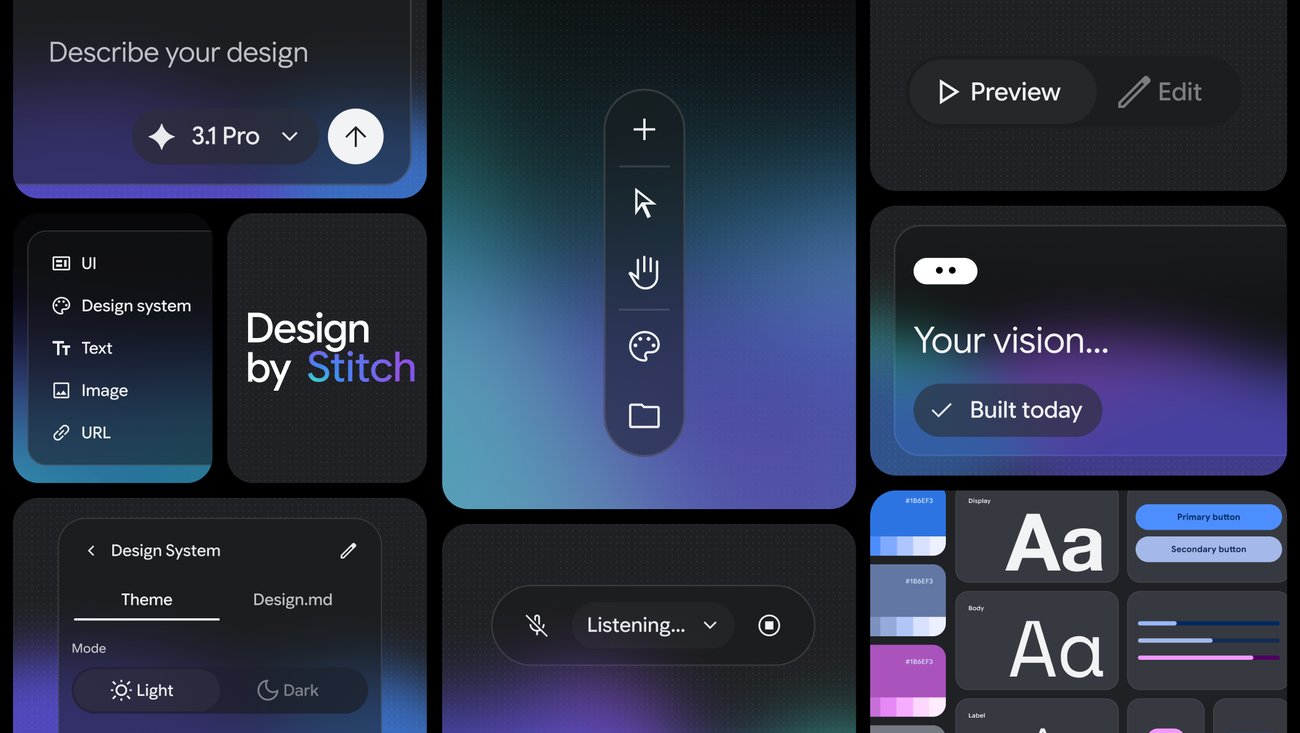
Google describes Stitch as an AI-native software design canvas for turning natural language into high-fidelity UI. The new version adds an infinite canvas, context from images/text/code, a design agent that can reason across the project, an Agent manager for exploring multiple ideas in parallel, design-system extraction from any URL, DESIGN.md import/export, interactive prototypes, voice critique, and export to developer tools like AI Studio and Antigravity.
That is a big statement: Google is not only saying AI can code. Google is saying AI can participate in the design process.
My take is that Stitch validates the category we have been building toward. The first AI-generated screen is not enough. Teams need divergence, convergence, critique, context, design systems, prototypes, and a path to code. That is exactly why design-aware AI matters.
The caveat: design tools win or lose on workflow fidelity. Can the system preserve brand? Can it use real components? Can it produce editable structure instead of a pretty dead-end? Can designers keep control? Can engineers trust the output?
Stitch is important because it pushes the conversation from “prompt to UI” toward “AI-native design workflow.” That is the right conversation.
For designers: Google just validated AI design, but not the full design workflow
The other design announcement that stood out to me was Google Pics.
TechCrunch called it Google declaring itself a contender in AI design. I think that is right. Pics is aimed at people who need visuals quickly: teachers, small businesses, marketers, teams inside Workspace. It can generate visuals from prompts and, more importantly, make parts of the design editable. Click an element, comment, change the time on an invitation, adjust the output without rerolling the whole thing.
This is the correct direction. The first AI-generated image is rarely the final asset. The same is true for UI. The magic is not generation; the magic is controlled iteration.
But here is the designer’s caveat: professional design is not only “make me a graphic.” It is hierarchy, spacing, brand systems, components, variants, accessibility, flows, states, naming, collaboration, comments, handoff, and the ability to keep improving the same artifact over time.
That is why I believe design-aware AI matters more than generic image generation.
Google is validating the direction: everyone will expect AI to help them create visual work. But designers will still need tools that understand product design, not just pixels. They will need AI that can stay on brand, use components, respect variables and tokens, and move between canvas and code without flattening everything into a screenshot.
That is exactly the gap Anima is built around: AI with an Eye for Design. Not just “generate something pretty,” but turn ideas, Figma files, URLs, screenshots, or prompts into real, interactive, editable product work.
For engineers: vibe coding is becoming mainstream, but quality gates are coming back
Google AI Studio adding native Android vibe coding is a major signal. When Google lets people prompt an Android app, preview it in an emulator, connect a device, and eventually involve testers, the category is no longer niche.
Vibe coding is becoming a normal way to start software.
But The Verge noted an important limitation: Google is positioning the first release around personal utility apps, hardware-enabled experiences, and Gemini-powered experiences. And publishing to Google Play still needs to meet Google’s quality and review standards.
This is the part engineers should care about. AI can lower the cost of starting. It does not remove the need for architecture, testing, quality, security, performance, and maintainability.
In fact, the more AI-generated apps there are, the more valuable engineering judgment becomes.
The engineer’s job shifts from “write every line” to “own the system.” Which parts are generated? Which parts are trusted? Which parts are throwaway? Which parts need tests? Which patterns should the agent follow? Which code should become a component, a library, or a real product surface?
That is why I like workflows where AI output is not trapped inside a black box. You need code you can inspect. You need a preview you can test. You need a way to connect design intent with implementation. You need handoff to coding agents and developers without copy-paste chaos.
This is also why “code playgrounds are the new design files” keeps feeling more true. The artifact that matters is increasingly not a static mockup or a prompt transcript. It is a live, interactive project that both designers and engineers can understand.
The uncomfortable Search story
Google Search becoming more agentic is probably the biggest platform story, and also the most uncomfortable one.
For users, AI Search can be better. It can answer directly, adapt the layout, use files and images as inputs, generate explanations, and maybe remove a lot of friction from everyday research.
For the open web, it is more complicated.
If Search becomes an AI-generated interface that summarizes, remixes, and completes tasks, then websites become less like destinations and more like raw material. Publishers already worry about AI Overviews. Generative UI and information agents push that even further.
From a product perspective, this is logical. Google wants to keep users in Google. From a web perspective, it changes the incentive structure. If fewer people click out, fewer creators get rewarded for making the content that AI systems learn from and reference.
I do not think this tension goes away. It becomes one of the defining product ethics questions of the next few years: how much of the web should be absorbed into an AI interface, and how much should remain a place people actually visit?
The designer-engineer takeaway: tools are converging
Google I/O 2026 makes one thing clear: the wall between design tools, coding tools, productivity tools, and search tools is getting thinner.
Designers will not only make static screens. They will increasingly shape systems, prompts, components, states, and interactive prototypes.
Engineers will not only implement tickets. They will increasingly supervise agents, define constraints, review generated code, and decide what should graduate from prototype to product.
Founders, PMs, and marketers will expect to describe an idea and get something real back quickly. Not a moodboard. Not a mockup. Something clickable, testable, and shareable.
That is the new baseline.
But the winning tools will not be the ones that only generate the first draft. The winning tools will be the ones that help teams keep going after the first draft: edit, align to brand, connect data, publish, copy back to Figma, inspect code, hand off to agents, and maintain quality.
Where Anima fits in this new world
Google’s announcements are a massive validation of the direction Anima has been moving toward: design and code are collapsing into one workflow.
Anima Playground is built for that moment. Start from a Figma design, a prompt, a screenshot, or a website. Generate a working web app. Iterate by chat. Keep the visual language. Inspect the code. Connect data and auth. Publish. Export. Hand off through MCP to coding agents when the project needs to move deeper into engineering.
Buddy brings the same idea back into Figma: a Figma AI design agent that can work with components, variables, tokens, Auto Layout, and editable layers instead of producing generic design slop.
That is the part I think matters most after Google I/O 2026. AI will be everywhere. The differentiator will not be “we have AI.” Everyone will have AI.
The differentiator will be whether the AI understands your workflow.
Final thought
Google I/O 2026 felt like a line in the sand. The AI assistant is no longer waiting politely in a separate chat tab. It is moving into the search box, the inbox, the document, the design tool, the IDE, the phone, and the glasses.
That is powerful. It is also messy.
My optimistic take: more people will become builders, and more businesses will operate with digital employees. My skeptical take: a lot of generated work will still need taste, structure, and engineering discipline before it becomes real product.
For designers and engineers, the opportunity is not to fight the shift. It is to own the quality layer above it.
AI can create the first version. Great. Now the real work begins: make it useful, make it beautiful, make it on brand, make it maintainable, and make it something a team can actually ship.
Try Anima Playground to turn AI-generated ideas into real, design-aware product work.
Try Designing with AI
Anima creates websites, apps and UX design from a prompt, try it here:
Sources and further reading
- Google: I/O 2026 announcements
- Google: Introducing vibe design with Stitch
- Google Cloud: What Google I/O ’26 means for developing agents
- The Verge: The 13 biggest announcements at Google I/O 2026
- WIRED: Everything announced at Google I/O 2026
- TechCrunch: Google and AI design tools
- The Verge: Google AI Studio native Android vibe coding
- AP News: Google announces AI advances at I/O
- TechRadar: Gemini is becoming impossible to avoid