
 Figma
Figma API
API Web to code extension
 Adobe XD
 Discord
 Twitter
 GitHub


 Blog
Blog
Introducing Anima, the UX Design agent7 min read
Reading Time: 5 minutesToday, we are launching Anima, the UX design agent.
Design is code. Anyone can ideate with LLMs in vibe-coding platforms and go from idea to concept with zero design or coding skills. But that doesn’t make everyone a professional designer. LLMs still have a big gap: they are design-blind. The result is AI slope, and the same pink-purple UIs everywhere.
Anima understands your brand and design system, and it plays well with other agents via MCP. In this new world, code playgrounds are the new design files. Shareable, versioned, and ready for handoff. With a few key differences: they are real code, responsive, with data and auth. Design as code serves as a shared language for humans and AI, and prototypes can now cross the line and turn into real, working apps and websites.
Key takeaway: Unlike other coding/designing agents, Anima understands your brand and visual language as you ask it for design drafts.
Welcome to a new era of design.
Design became a bottleneck
Coding agents are exploding because they allow anyone to code and ideate, but most of them are design blind, making them irrelevant for professional teams.
Today’s coding agents do not understand your design system, your brand, your existing UI patterns, your product flows, or the constraints that make real teams productive. They can generate screens, but they lack the design and UX context.
Product teams are hitting a productivity wall. Code & Product research are delivered with the speed of AI, 10-100x faster than 2 years ago, while design is fully manual. Design has become a bottleneck.
The design stack is waiting for an AI disruption, and today is that day.
Design is code
In 2026, design is no longer a static artifact.
It is a runnable, interactive code. It can talk to APIs and hold data. It can be versioned, reviewed, and merged. It can be handed from one agent to another. It can go to production with far less translation.
In this AI-first world, code is the new canvas, a powerful language, shared between agents.
We’re seeing this shift with the rise of vibe-coding and technical designers starting to work in IDEs. The line between concept, prototype, PoC, MVP, and real product gets blurry fast. That blur is not a bug. It holds the next unlock for design at scale.
Designers (and non-designers) produce code projects as much as static designs today – These code projects are a new type of design files, and need to be sharable, versioned, and ready for handoff.
Anima Playgrounds as the new design files
Anima Playground is a vibe-coding environment that is design-first, focused on brand consistency, and at the same time has all the vibe-coding features you need for ideation (And some more).
But the bigger idea is this: Playgrounds are the new design files. Shareable, runnable, versioned, with real data, and ready for handoff to an AI coding agent.
Instead of drawing every pixel of every variant manually, then writing a spec, hoping engineering gets it, you share a link to a running artifact. Instead of a handoff based on text and pixels, you build and handoff a code project to the coding agent, Cursor/Clause/Codex, speaking the same language.
Core vibe-coding features:
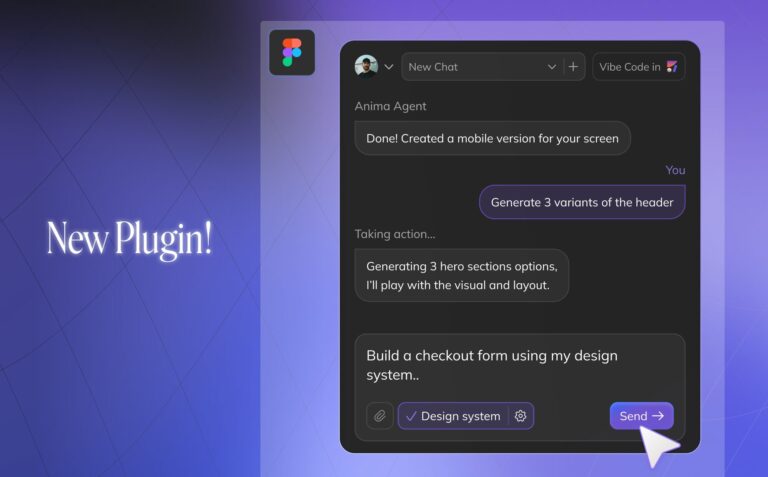
- Chat with Anima design agent — Chat and attach images/Figma to add functionality.
- Versions — Google-docs grade versioning, snappy preview, and jump between versions.
- Selection tool — Point to the relevant layer to reference in chat.
- Text edit tool — Edit text quickly in-place.
- Dictate — Use voice to tell Anima your desired changes.
- Web research tools — e.g. “Fill this landing page with the content of this article [link]”.
- Image editing — Powered by nano-banana, e.g. “Create an image of a spy raccoon”.
- Image uploading — “Update the about page with my image [attachment]”.
- More features drop daily.
In this new world, design is code. However, coding agents lack the design context, and are design-blind in most cases. Causing an AI slope in UX design, where everything is pink-purple.
Enter Anima, a design agent inside our vibe-coding environment, with the context of your brand and design system.
Anima playground is a design-oriented vibe-coding environment, built for the UX design process, from creation – collaboration – and handoff.
Anima is a design agent, built for visual consistency
Anima is the fastest way to bring your brand, your UI language, and even specific screens and flows into an editable, runnable vibe-code environment. No design skills required. No code skills required.
There are a few ways to bring design context into Anima:
- Start with a prompt and a brand — “Create a SaaS dashboard with the brand of acme.com”
- Clone your live website — Simply paste a link to your site at Anima.
- Clone a webapp behind login — Use Anima’s Chrome extension to copy screens to Anima.
- Paste Figma links — As a starting point or in a project to add a second screen/modal/section.
- Full Figma prototype import — Using Anima’s Figma plugin.
- Copy components from the web — Use Anima’s Chrome extension to capture any element.
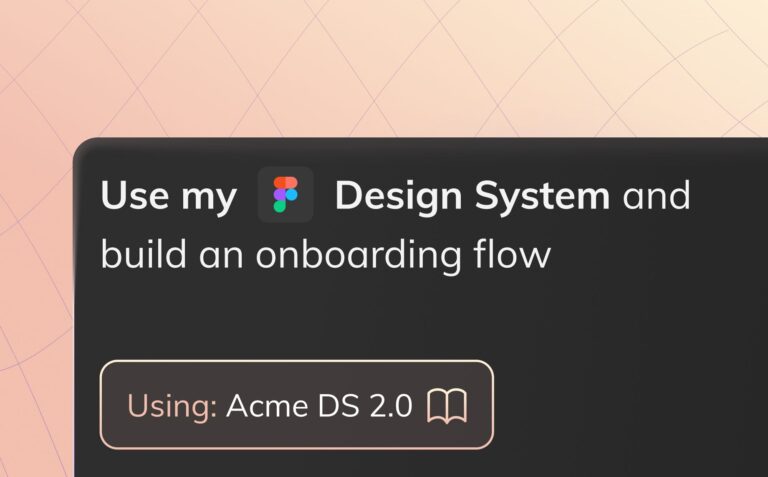
- Design system — Orgs can bring in both a code design system and a Figma design system.
Unlike other coding/designing agents, Anima understands your brand and visual language as you ask it for design drafts.
Anima is built for teams
Most agent tools are built for one person at a time.
Anima is built for teams. You create in a shared, secure workspace. Context is shared. Playgrounds are shared. Brand guidelines are shared. The more a team uses it, the better the results get.
Anima is designed to become part of a team’s workflow:
- Ideate in Anima with the context of your product and brand.
- Share internally or publish publicly.
- Handoff to engineering with MCP, or download code.
Design systems & vibe-coding
Anima can utilize your code design system when it creates new designs.
Meaning that when you prompt, or give Anima wireframes, flow charts, or even a napkin drawing, the output stays consistent with your components, tokens, conventions, and brand.
This is where design democratization becomes real. Anyone can create, without breaking the system. Developer handoff is a breeze, as coding agents get code that complies with your front-end.
Figma design systems & vibe-coding
Sometimes your design system lives in Figma, and that is the source of truth.
This is usually true before a rebrand or when creating new components. And sometimes, it’s just easier to get the Figma file than to integrate the code DS.
You can bring your Figma design system into Anima.
Then, anyone in the org can use it to ideate by simply prompting.
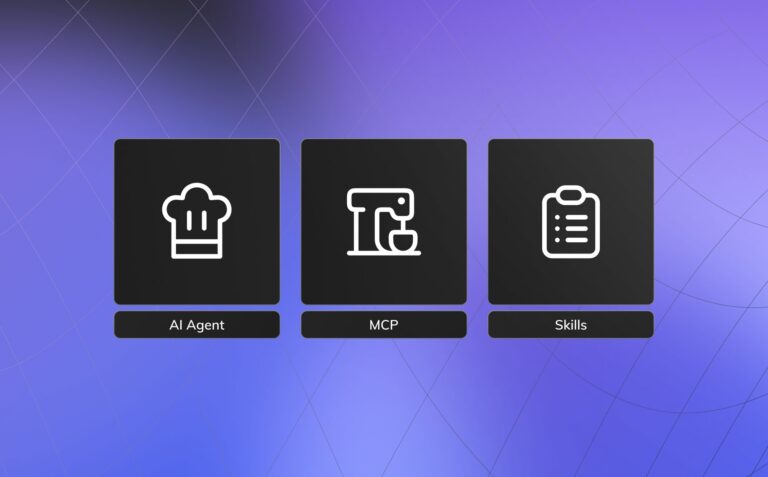
Handoff to coding agents via Anima MCP
This is the part that makes Anima a real member of the AI swarm.
With Anima MCP, coding agents like Cursor and Claude Code can read the playground’s code, understand the structure, and take it to production. And because the playground is already built on your design system, the UI layer is not a rewrite. It is a continuation.
Crossing the lines: Database and a login
A prototype used to be a dead end.
Now, prototypes can be the beginning of a product, an internal tool or a public one. You can publish, connect a domain, and keep going. We also added primitives that matter for real internal tools and real workflows: A built-in database and auth.
This means non-technical users can bring rich data, build internal or personal tools, and share them securely with the team or clients, without turning every idea into an engineering project.
What happens to designers
Design is not going away. It is scaling thanks to AI.
When execution becomes cheaper, taste, judgment, systems thinking, and product intuition become more valuable. Designers shift from pushing pixels to owning the design system lifecycle, guiding the product language, and supervising agents that can generate and iterate at insane speed.