 Figma
Figma API
API Web to code extension
 Adobe XD
 Discord
 Twitter
 GitHub


 Blog
Blog

Working Alongside Agents: AI Teammates8 min read
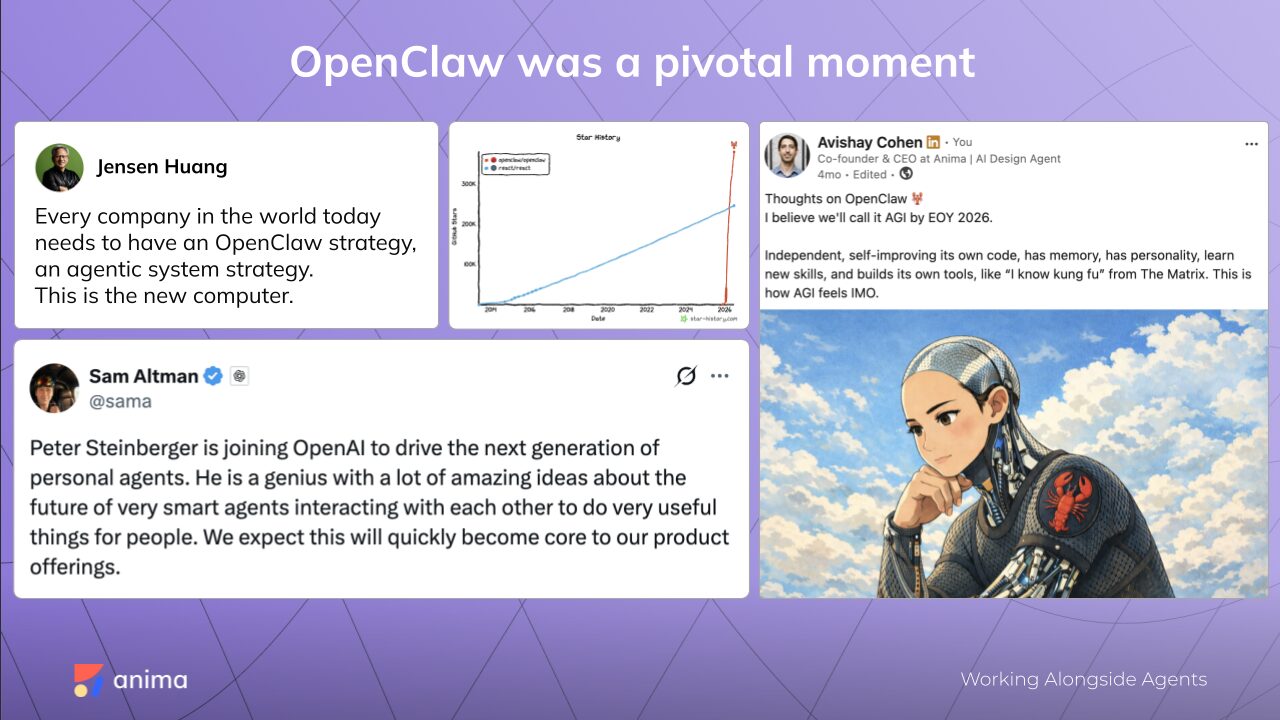
Reading Time: 6 minutes6 months post the OpenClaw pivotal moment, we have 7 agents as part of the team, and man, they deliver. I love this quote because it’s exactly how I feel now –
“Aliens have landed here, and they are ready to work, cheap and at scale.” – Daniel Schreiber, CEO of Lemonade
In this series of articles, I’ll cover what it looks and feels like to work with agents, lessons we learned, and best practices we adopted. But first, let’s start with an intro to where we’re at and what I think every CEO, founder, and leader should know, as it applies to you today. Your workplace, methodology, and team are about to change dramatically, and you should set your mind to it to make the best out of it.
Our agentic teammates at Anima operate across Marketing, BI, QA, Customer Success, and Back-office operations. They sit in our Slack channels. They pick up work at 2 a.m. or run on daily loops. They research, analyze data, publish content, open Asana tickets, and ship pull requests for engineers to review.
Each agent reports to a human manager who onboard it, gives it context and constant feedback, expands its abilities and toolset, sets its routine, and sets it up for success as part of the team.
Agents vs AI chat
Today’s agents (OpenClaw, Hermes) feel more like remote teammates than chatbots. It changes how we interact with them and what we expect from them.
They have their own computers. A physical one or in the cloud. An agent also does not switch off when you close the laptop. It can download gigabytes of data, analyze it for hours, wake up at night for tasks, do research, and take actions. Essentially, work.
They learn. You onboard them. You send them off to read materials online or offline and conduct research for the benefit of their knowledge. They understand the domains you wish them to own better with every task and feedback.
They get access to your data and systems. So, they execute tasks end-to-end. You can bring them into the company’s messaging app like Slack or Teams, so they have long discussions with multiple team members in the open.
They collaborate. Unlike your Claude Cowork / Codex, a shared cloud agent can learn from several people and make that knowledge available to everyone. A product manager can teach it about analytics. Marketers can teach it about attribution and the funnel. Engineering teams can give it access to code and a development environment. The same agent can then make connections across those domains.
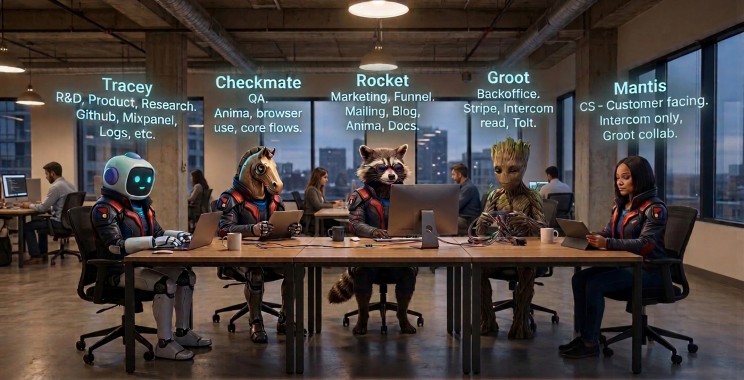
Our agents at Anima
I’ll write more about our agents, but here’s a taste –
Rocket, the marketing agent, reports to me. He’s an expert in our WordPress blog setup, SEO tactics, voice and tone, newsletter list setup, email templates, funnel, and analytics. He understands the product well and also has access to it and has his own Anima account.
Part of his routine includes funnel monitoring and updating his knowledge from channels around product, tech, and marketing activities so it’s always a sharp analysis, not a generic one, and no extra context needed. It looks into tests we did in SEO and monitors them.
It helps with writing and translating blog posts, finding funnel friction points or failures, and executing our monthly newsletter tasks from maintenance to composition, and all the way to sending emails. We still manage it, but he does the daily grunt work. He comes with insights and executes upon it.
Tracey, our most mature agent, reports to the CTO. She’s an expert in Business-intelligence / Product analytics, log traces, error reports, and our codebase. Some of her routines include being an on-call engineer, waking up on user complaints, tracing the issue, submitting an update to the code (PR), or opening a ticket on the task management system, and updating on its findings and actions in Slack, of course. That’s about 5% of what she does.
The digital employee singularity
I believe we have crossed what I call the digital employee singularity: the point at which agents become capable enough to join the workforce as an operating layer, not just as software used by the workforce.
Agents are magic that you still have to work hard for. The setup is still closer to DIY crafting than to a managed service. They need training, maintenance, supervision, and lots of love and care. But the effort is worth it, because it is like building fishing rods instead of catching fish. Once an agent works well, its value keeps compounding.
Not everyone is excited about AI
This is a big shift, and it should be managed from multiple perspectives: business, work methods, security, tech, and most importantly, people.
There’s a great discussion about how AI makes people feel with Noam Segal at Lenny’s. It’s an important mirror for all of us in “Group 1” – The excited group. 72% worry about layoffs. Many people are confused, uncertain, or stressed about the future for various reasons.
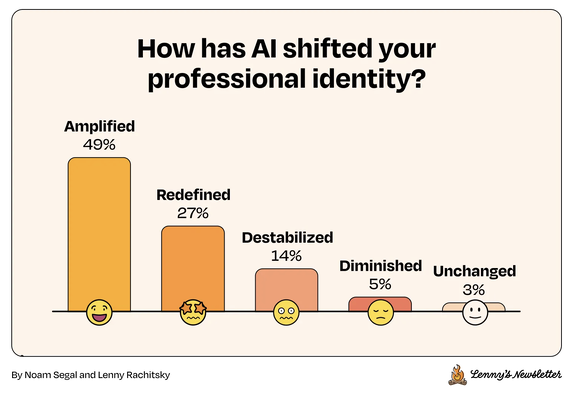
I believe a big part of managing this change, and also getting the most out of it, is transparency and going through this shift together as a company, as a team. One thing we do is we have an “Agent stories” corner in our company weekly session. There are two goals for it –
We learn together. All my team are sharp people, and they all use agents in different ways every week. This is a brave new world, and we learn faster if we learn together. There’s a huge psychological impact to having agents as part of the team, so instead of working in the dark, I prefer having it in the open and having all my smart team as part of this adventure, as exciting and freaky as it is.
Here are some agent stories –
- One of our agents sent a customer-facing message when it was only supposed to leave an internal comment. No harm done, but a small “???” from the user, answered with an honest response.
- One email failed because we had never clearly stated which errors are fatal. A newsletter was sent from the wrong subdomain, which caused 166,000 emails to be suppressed. No harm done this time, but we learned to define our tasks better.
None of these failures came from an agent being unable to use the software. They came from ambiguity, authority, and coordination.
The most important question is therefore not, “What can this model do?”. It is, “What authority should this agent have, on whose behalf, and under what supervision?”
Put agents on an org chart
Using ChatGPT, we got used to doing research much faster, iterating on copy, or bouncing off ideas with an AI partner, but this is something else. The right way to use an agent is not to micro-manage it and ask for every small task.
Give your agent knowledge, domain understanding, and access to tools and data, so you can then give it a goal, not a small task. And it’ll find the way, similar to a human. It will also make mistakes. And you should tell it, because it remembers and learns.
That makes it much closer to a junior operator than to software or AI Chat.
Every agent needs a named human owner. Without someone nurturing it, correcting it, and expanding its abilities, it becomes less useful over time. Things keep happening in your business. Company terminology changes. Metrics change. Brand positioning changes. New tools are introduced. An agent is not a one-time implementation.
You train agents like new employees. You trust agents like new employees.
This is also why I strongly recommend not rushing to create 100 agents. Start with one. Add another only when the separation is necessary for scope, security, or specialization. We have spent months trying to keep the number of agents as low as possible while making each one smarter and more capable.
More agents also create more management overhead. Do not deploy more agents than your organization can manage.
Where to start
A new agent should begin at the lowest level that still creates value, and expand later. Replace prompts with operating procedures
The setup effort for an effective agent is not mainly about writing a brilliant prompt. It is closer to training a new junior for well-defined tasks.
The strongest agents accumulate capabilities over time. They configure their computers, install tools, create skills, keep working files, and build knowledge from prior tasks. When we need a new agent with a similar foundation, we can back up and clone the machine, which saves some onboarding effort.
The model itself is becoming a commodity. We have changed model providers, and we may change again. The durable value is the agent’s accumulated context, capabilities, operating procedures, and integration with the organization.
Your model is rented. Your context is the core.
Go set up your first agent. I recommend Hermes. I’ll be posting more from our journey – follow me if you find it interesting.